Sep
17
2025
Museums and interpretive centers today have an expansive toolbox for interpretive planning: artifacts & specimens, labels, sound, light, illustration, video, scenic recreations, hands-on exhibits, projected media, and interactive media. But choosing the right tool requires intention. At Ideum, we design and build both physical and digital exhibits, and we believe that digital media should never be a default choice. It should be purposeful.
At Ideum, we approach every exhibition with the understanding that different stories require different tools. Our internal exhibition planning framework helps us determine when and why to use a particular type of media based on interpretive goals, visitor experience design, and physical context. This ensures that each exhibit element serves a clear interpretive purpose, not just an aesthetic or technological one.
Mechanical interactives
For example, hands-on mechanical interactives are ideal for encouraging sensory exploration, particularly for younger audiences or visitors who may not engage with written text. These interactives are especially effective for simple cause-and-effect learning, physical processes, or tactile discovery that would be lost in a purely digital experience.
Illustrations
Illustrations are used when content cannot be captured in a single photograph or object, such as speculative reconstructions, diagrammatic cross-sections, or scenes that combine many moments into one. They are also helpful in making content more accessible for children and in visualizing imaginary, prehistoric, or future scenarios.
Labels
Written labels provide grounding and context. They can convey key ideas succinctly, offer quotes or personal perspectives, and provide consistent, repeatable access to core content. Labels can also serve as an inclusive tool, especially when used across multiple languages or paired with visual content, like photographs.
Participatory interactivesFor emotionally complex or socially resonant topics, participatory interactives are often the most appropriate. These invite visitors to contribute their own thoughts, reflect on others’ perspectives, or engage in expressive activities. In these contexts, media that facilitate empathy, emotional response, or creative expression may be more impactful than any screen-based experience.
Our exhibit design framework also includes guidance on when to use linear media, display objects, audio, immersion, and scenic environments, with each evaluated based on its ability to meet specific visitor outcomes. We don’t view technology as a default solution, but as one option within a diverse and flexible toolkit. This intentional approach to museum planning allows us to design exhibitions that are not only innovative but also meaningful, inclusive, and effective.
So, when is interactive digital media the right choice? We’ve found it excels in a few key ways:
Some of the most meaningful stories in science, history, and culture are hidden from view. They might be embedded in sacred or fragile artifacts, or obscured by the limits of lighting, scale, or conservation requirements. Digital media can reveal these hidden dimensions, allowing visitors to experience the full richness of an object or place without compromising its integrity.
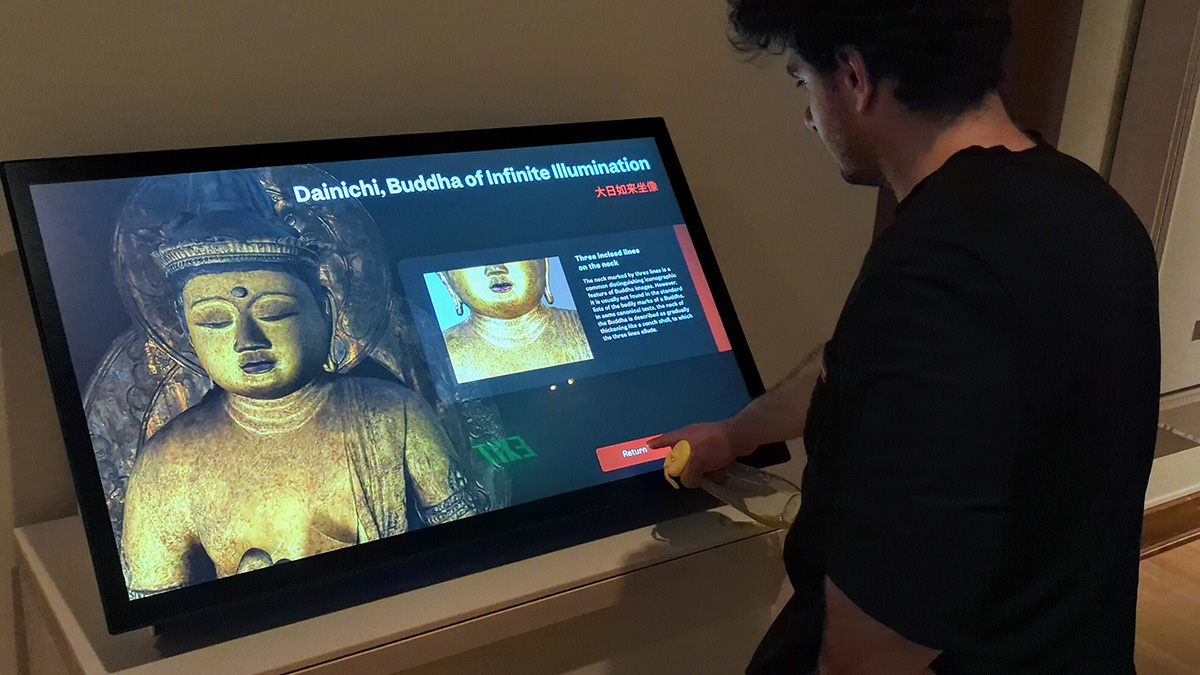
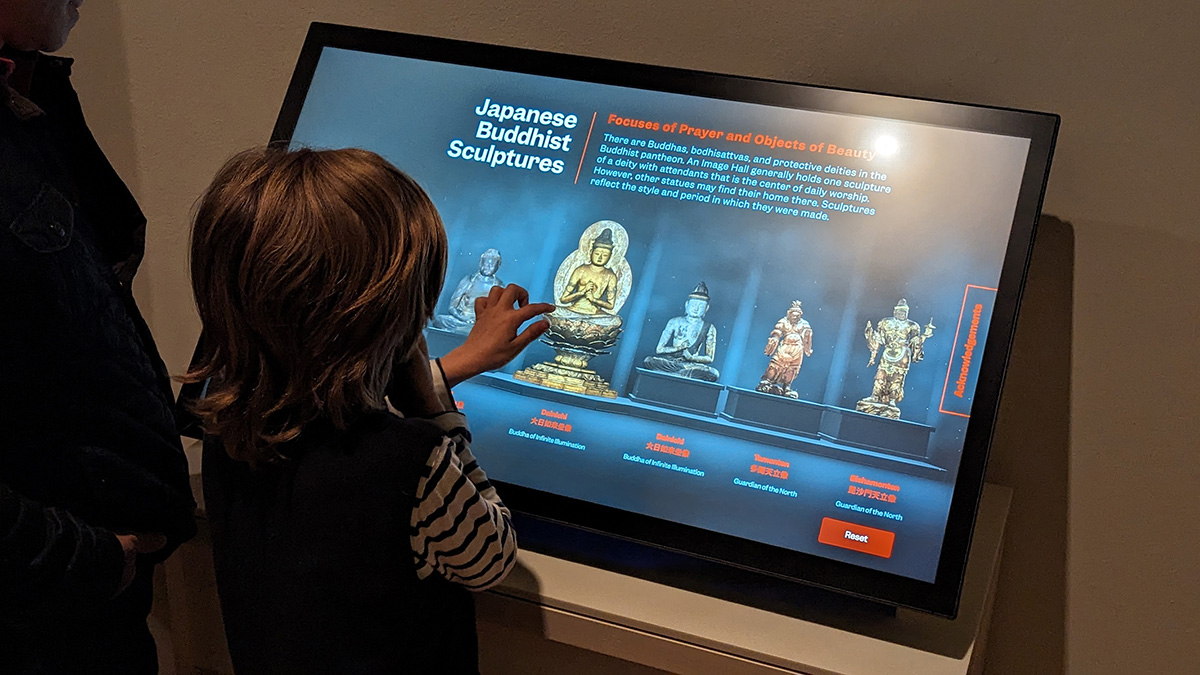
At the Museum of Fine Arts Boston, our Virtual Japanese Buddhist Temple Room interactive allows visitors to explore sacred sculptures in ways that would be impossible inside the physical gallery. Visitors can zoom in to see fine carvings, hear from conservators about preservation work, and watch animated sequences that explain traditional Japanese temple construction methods. The digital interface expands access while maintaining reverence for the sacred space.
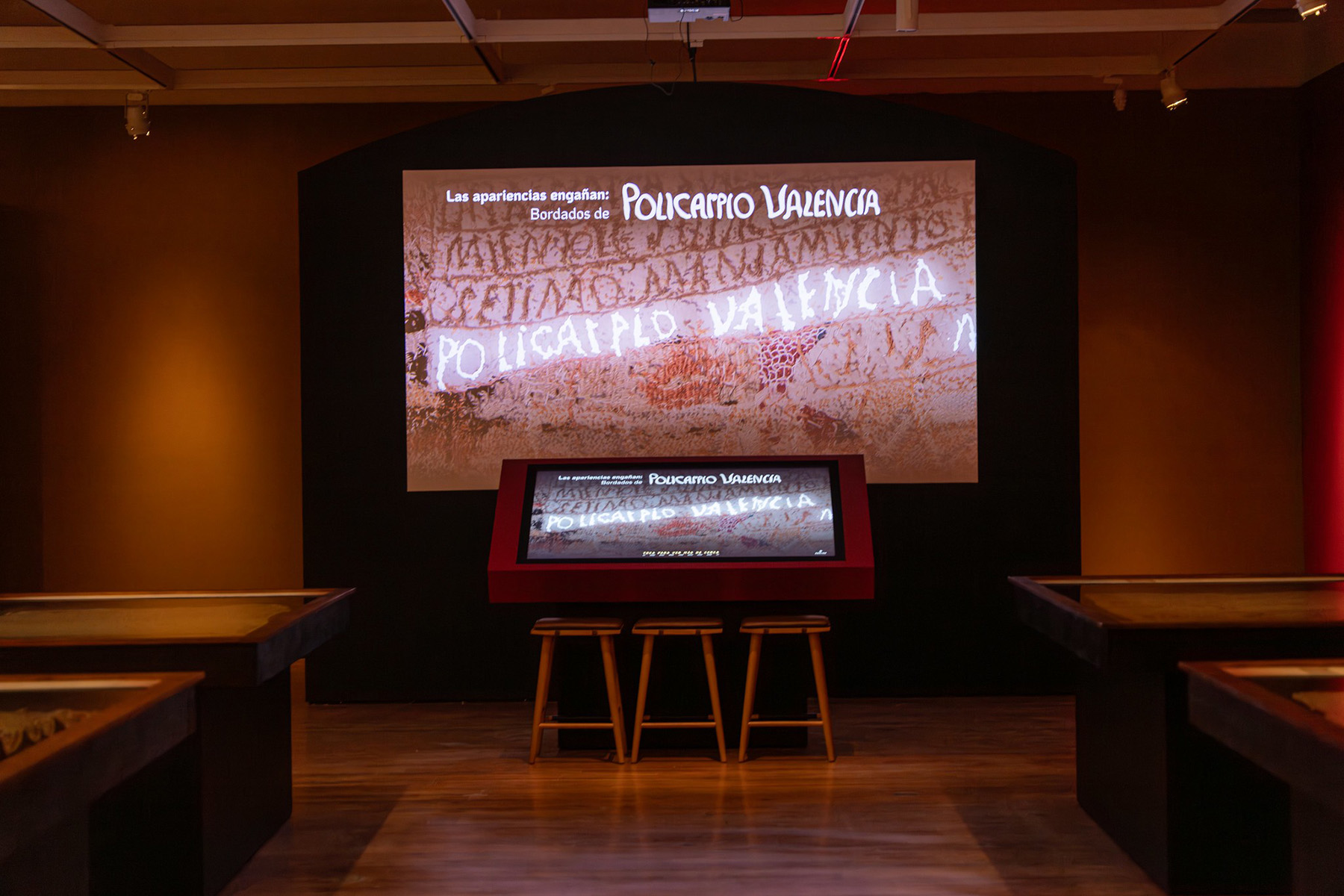
At the Museum of International Folk Art, our interactive for Appearances Deceive allows visitors to explore intricate embroidered textiles by artist Policarpio Valencia. Guests can zoom in to examine fine stitching, flip the fabric to view both sides, and hear narrations of the poetic messages sewn into the work, in two languages. The experience brings voice, artistry, and language together in a format that enhances what’s on display without overwhelming it.
Some exhibit topics involve large-scale patterns or dynamic systems that are difficult to explain with static displays. In these cases, digital media helps visitors see change over time, connect related elements, and understand cause and effect across long durations or vast landscapes in micro or macro scales.
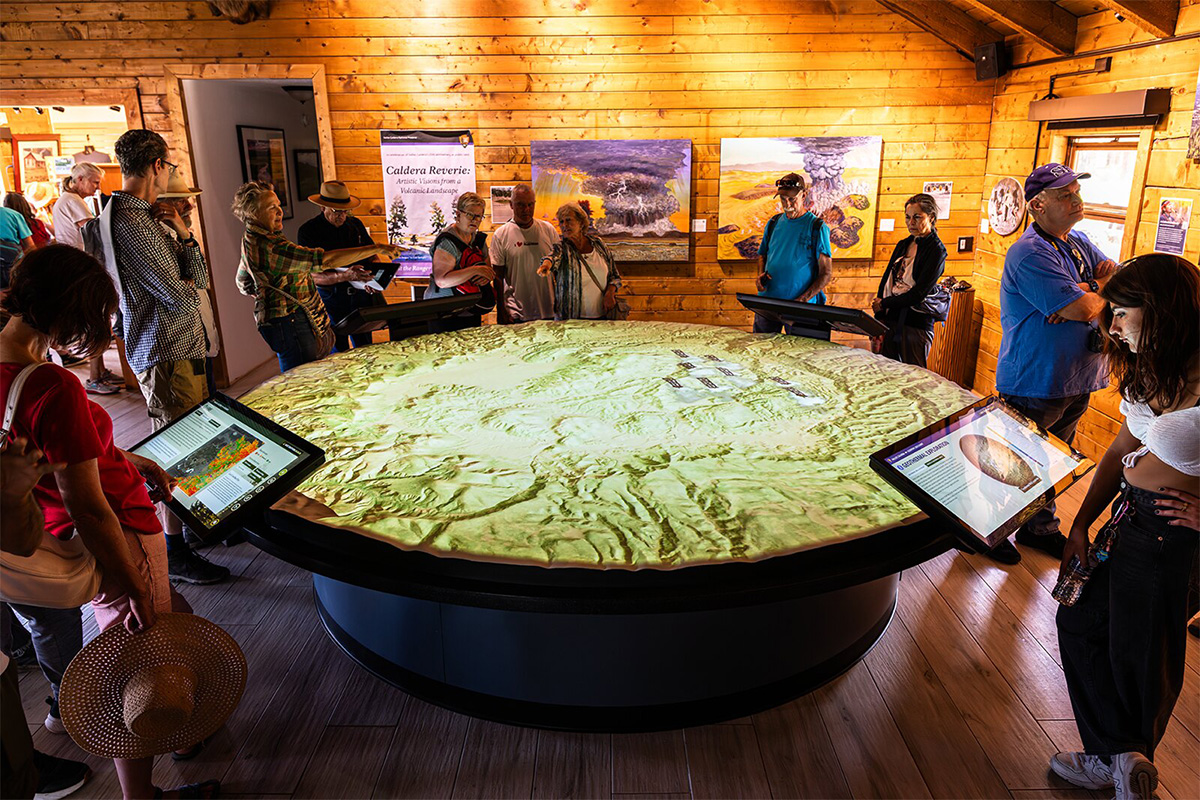
At Valles Caldera National Preserve, we designed an interactive projection map table that helps visitors see the living landscape as a dynamic system. Through animated visualizations, guests can explore volcanic eruptions, seasonal cycles, wildlife migration patterns, and watershed flows. This makes it possible to trace the long arc of natural and cultural history through time and terrain in a way that static maps or photos could not achieve.
When an environment is too distant, dangerous, or inaccessible for most people to visit, immersive digital media can bridge that gap. Projection, sound, and motion-triggered effects can transport visitors to new places and give them a sensory experience of something they might otherwise only read about or imagine.
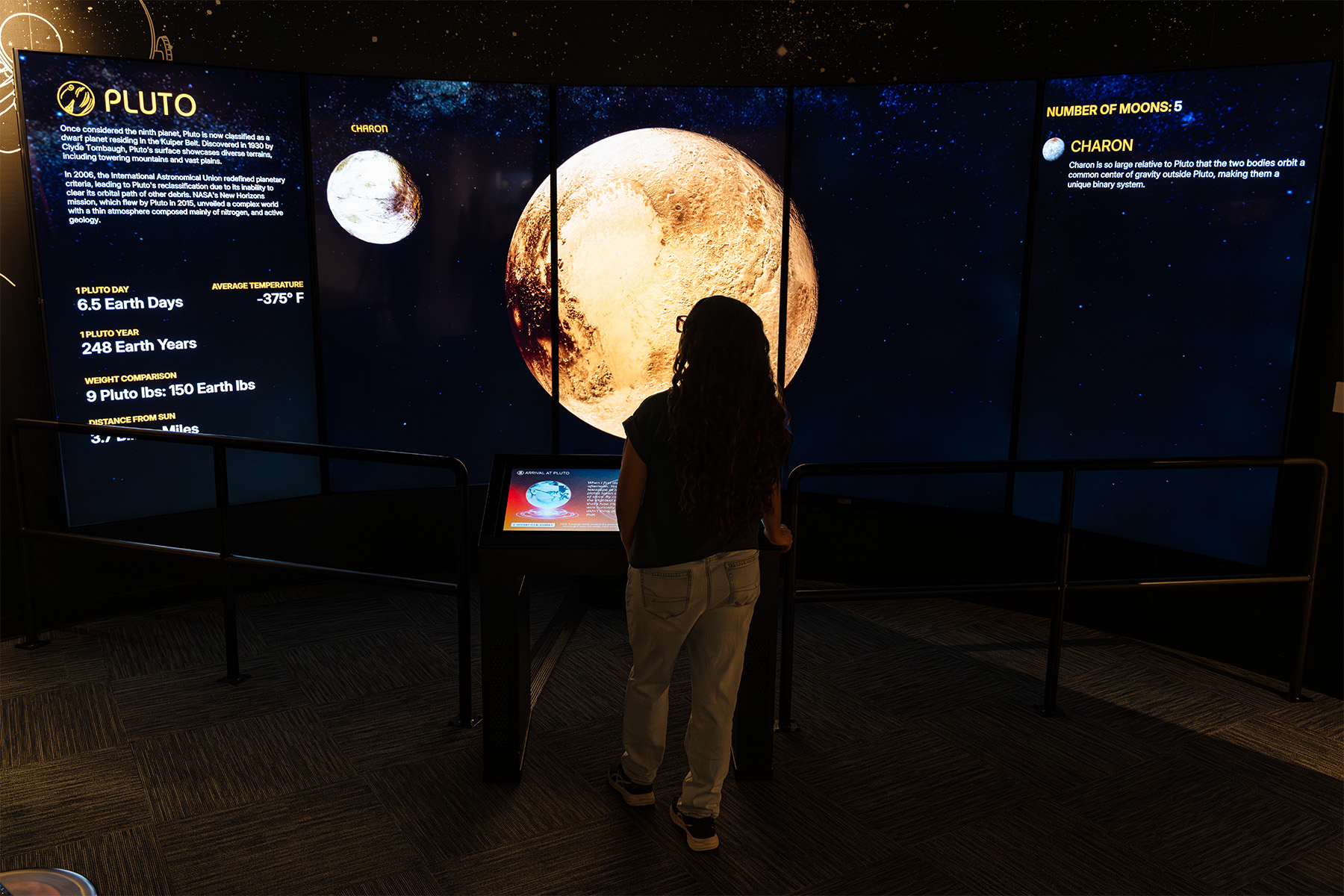
Our Journey to Pluto exhibition at the Las Cruces Museum of Nature and Science does just that. Through large-scale projection, motion-activated digital effects, and rich NASA imagery, visitors follow the path of the New Horizons mission across billions of miles. They experience what it feels like to enter deep space, encountering a remote world that only one spacecraft has ever reached and no human eyes have seen firsthand.
Museums serve diverse audiences. Visitors come from many backgrounds, speak different languages, and vary widely in age and interest. Digital media makes it possible to offer layered content in a flexible, user-driven format, so each visitor can explore on their own terms and in their preferred language. By layering information, we can provide depth for experts while also offering clear orientation and basic context for those new to a subject. Tiered text and optional content paths help reduce visual overload and eliminate the “sea of text” that some museums rely on when trying to speak to everyone at once. Instead of crowding the physical space, layered digital interfaces make content bite-sized, discoverable, and responsive to a visitor’s curiosity.
Our upcoming TouchStory Studio platform has made this possible for institutions like the New Mexico Museum of Natural History & Science. In their exhibitions, a mural display is enhanced with touchscreen interpretation. Visitors can select from multiple languages, access additional images, specimens, and videos, and explore content at a pace and depth that suits them. This improves access for all audiences without visually crowding the physical space.
Digital media is one part of a larger interpretive toolkit. When used with intention, it can illuminate what’s unseen, invite participation, or make complex ideas tangible. It doesn’t replace other forms of storytelling; it strengthens them. At Ideum, we design digital experiences to complement physical environments, objects, and human voices, integrating media with the same care we give to content, context, and craft.